Visual description
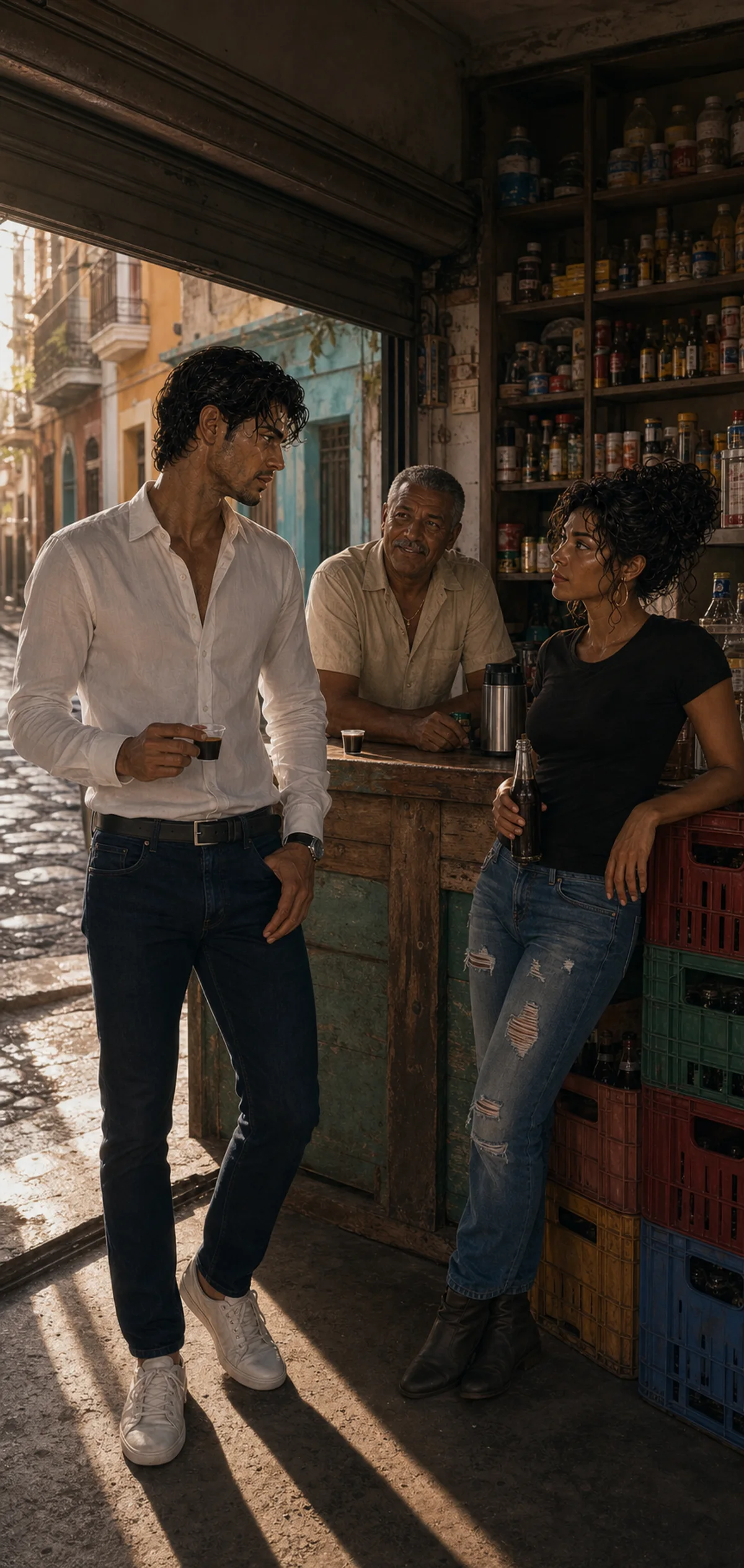
At dawn inside the colmado of Don Ramón, Max holds a tiny coffee while Sofía regards him with sharp amusement from the beverage crates and Don Ramón smiles between them.
Chapter 4
The Colmado
Max · 6 min
Wednesday Morning
Casa del Diseñador
The silence woke me up.
I lay in the center of a four-poster bed draped in white linen. The room was freezing. The AC unit was humming a low, white-noise lullaby that was designed to erase the world.
Beside me, Cata was asleep. She slept on her back, hands resting lightly on her stomach, her silk eye mask perfectly centered. She looked like an effigy on a tomb. Beautiful. Cold.
I checked my phone. 6:30 AM.
I couldn't breathe.
It was the same feeling I got in the penthouse in Jersey. The air was too scrubbed. It lacked oxygen.
I slid out of bed, careful not to disturb the mattress. I grabbed the clothes I had worn on the plane—jeans and a white button-down—and dressed in the bathroom.
I needed coffee. Real coffee. Not the Nespresso pod machine sitting on the mahogany vanity.
I slipped out of the suite and into the courtyard. The sun was just starting to rise, casting long, golden shadows across the tiles. It was humid, but fresh.
I unlocked the heavy pedestrian gate and stepped out onto the street.
The Zona Colonial at dawn was magic. The pastel buildings—ochre, terracotta, sky blue—glowed in the soft light. The streets were mostly empty, save for a few stray dogs trotting with purpose.
Then, the silence broke.
It started as a crackle of static, followed by a voice amplified through a loudspeaker that sounded like it was underwater.
“¡COMPRANDO BATERÍA VIEJA... COLCHONES VIEJOS... LAVADORA VIEJA... AIRE ACONDICIONADO VIEJO...!”
A battered pickup truck rolled slowly down the cobblestones. The bed was piled high with scrap metal, old mattresses, and rusted appliances. The driver, a man with a cigarette dangling from his lip, drove with one hand and held a microphone with the other.
“¡COMPRAMOS TODO VIEJO!” (We buy everything old!)
I stared at it, mesmerized. In Jersey, the HOA would have called the SWAT team. Here, it was the alarm clock.
It was loud. It was annoying. It was perfect.
I walked deeper into the neighborhood, away from the sanitized zone of the luxury hotels. I turned a corner and found a small plaza that felt lived-in. There were no tourists here. Just locals starting their day.
On the corner, there was a shop with open metal shutters. Inside, shelves were stacked floor-to-ceiling with everything from rice to rum. A colmado.
Music was already playing—a low, rhythmic Bachata.
I walked in. A man was behind the counter, wiping it down with a rag.
"Hola," I said, my Spanish rusty and formal. "Un café, por favor."
The man looked at me. He looked at my crisp white shirt, my expensive watch.
"Expresso?" he asked. "Cappuccino?"
"No," I said. "Whatever you are drinking."
He grinned, revealing a gold tooth. He poured a dark, thick liquid from a metal thermos into a tiny plastic thimble-cup.
"Azúcar?" he asked.
"Black," I said.
I took the cup. It was scorching hot. I took a sip.
It was rocket fuel. Sweet, strong, and earthy. It hit my bloodstream instantly.
"Good?" the man asked.
"Incredible," I said.
I leaned against the counter, watching the street. A woman walked by carrying a basket of fruit on her head. Two men were setting up a domino table on the sidewalk, arguing good-naturedly about the Yankees.
"¡Dímelo, tigre!" one of them shouted to a passerby.
I felt a strange loosening in my chest. The "Glass Box" felt very far away.
"You look lost, gringo."
I turned.
Standing at the other end of the counter was a woman.
She was leaning against a stack of Presidente beer crates, drinking a bottle of Malta Morena. She was wearing distressed jeans and a black t-shirt that read “Soy la Jefa” (I'm the Boss). Her hair was a riot of dark curls tied up in a messy bun, held together by a pencil.
She was looking at me with amusement, her dark eyes sharp and intelligent.
"I'm not lost," I said, straightening up. "Just... exploring."
"Exploring," she repeated. Her English was perfect, but flavored with a heavy, melodic accent. "You are standing in El Colmado Don Ramón at 7:00 AM wearing a shirt that costs more than Don Ramón’s car. You are definitely lost."
I looked down at my shirt. "Is it that obvious?"
"You scream 'Resort'," she said, taking a sip of her Malta. "Did you escape the tour bus? Or are you looking for the Ambar Museum? It opens at nine."
"I'm an architect," I said, feeling the need to defend myself. "I'm here for work. The Hotel San Nicolás project."
Her expression changed instantly. The amusement vanished, replaced by a cold, hard shutter coming down behind her eyes.
"Ah," she said. "The San Nicolás. The glass tower."
"Ideally, not a glass tower," I said. "If I have my way."
"You won't," she said flatly. "You developers are all the same. You come here, you look at our old stones, you say 'how quaint,' and then you cover it in glass and charge five hundred dollars a night for Americans to drink watery Mojitos."
She pushed off the crates and walked toward me. She was shorter than me, but she had a presence that took up the whole room.
"You like the coffee?" she asked, pointing to my tiny cup.
"It's great," I said.
"It costs ten pesos," she said. "Enjoy it. Because once your hotel opens, Don Ramón won't be able to afford the rent here anymore, and this place will be a gift shop selling plastic turtles."
I flinched. She wasn't just rude; she was right. And she knew it.
"I'm trying to preserve the history," I lied. Or, I hoped it wasn't a lie.
"Sure," she scoffed. She turned to the counter. "Don Ramón, deme una recarga. Cien pesos." (Give me a recharge. 100 pesos.)
She handed Don Ramón a crumpled bill. She turned back to me, her eyes sweeping over me one last time.
"Go back to your hotel, Architect," she said. "Before you get your white shoes dirty. The real Santo Domingo is not for you. It stains."
She grabbed her phone receipt from Don Ramón and walked out, her hips swaying with an effortless, confident rhythm that made my mouth go dry.
"Who was that?" I asked Don Ramón.
Don Ramón chuckled, wiping the counter.
"That? That is Sofía Mercedes. She owns the print shop down the street. Imprenta Mercedes."
He leaned in.
"Careful, amigo. She is fuego. She burns."
I looked at the empty doorway where she had disappeared. The scent of her—something like vanilla and fresh ink—lingered in the humid air.
"She burns," I repeated softly.
I finished my coffee. It tasted sweeter now.
I checked my watch. 7:30 AM. Cata would be waking up soon. She would want her list. She would want her marble.
I dropped a twenty-dollar bill on the counter—way too much, I knew, but I didn't have pesos yet.
"Gracias, Don Ramón," I said.
I walked back out into the sun. But instead of heading straight back to the Casas del XVI, I took the long way. I walked past the shop with the hand-painted sign: Imprenta Mercedes – Diseño y Soluciones.
The metal shutter was halfway up. I could hear the rhythmic clack-clack-clack of a printer inside.
I didn't go in. Not yet.
But for the first time in five years, I wasn't thinking about the blueprint. I was thinking about the fire.
Narration will appear here when the final recording is added.