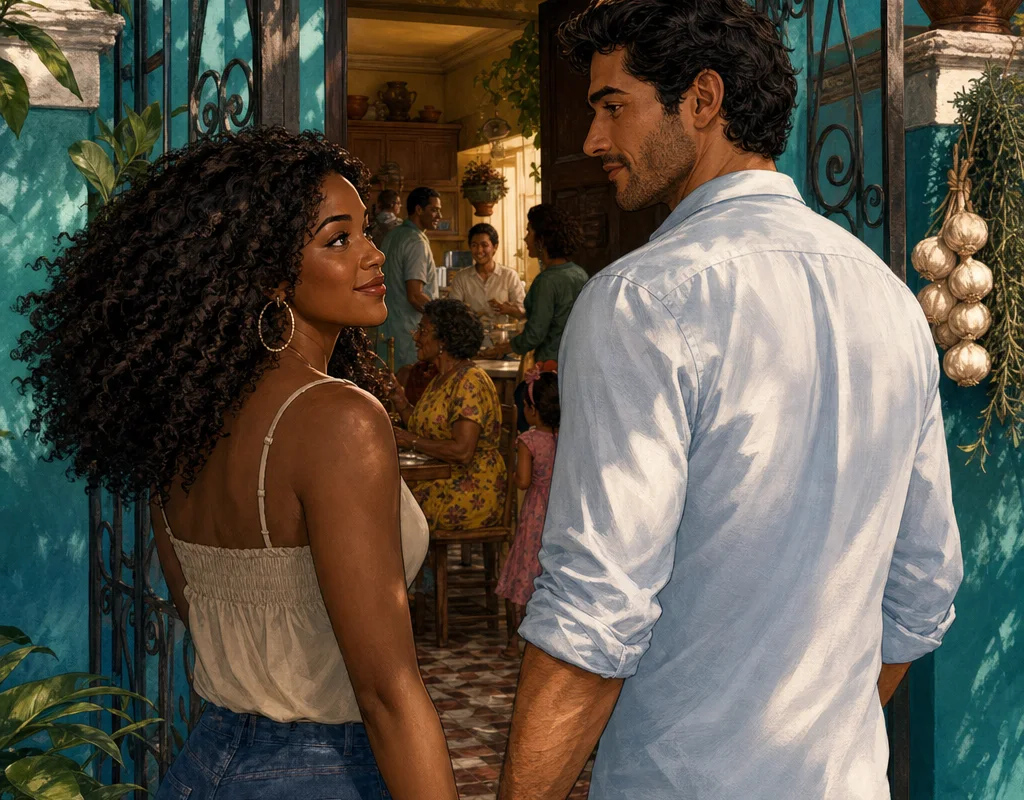
Visual description
At the open gate of Doña Tata's turquoise house in Los Prados, Sofía and Max hold hands and share a knowing look before entering the lively family gathering.
The House of Doña Tata
Los Prados
Sofía’s grandmother lived in a turquoise house in Los Prados that smelled of garlic, oregano, and slow-cooked meat from three blocks away.
The gate was open. Bachata music was blasting at a volume that would be illegal in New Jersey.
"Ready?" Sofía asked, squeezing my hand as we stood on the sidewalk.
"I've faced boardrooms of angry investors," I said. "I can handle a grandmother."
"You have no idea," she muttered.
We walked in.
The house was an explosion of life. There were at least twenty people inside. Uncles shouting at a baseball game on TV. A group of women laughing in the kitchen. Kids running around with juice boxes.
The noise stopped the second we stepped into the living room.
Twenty pairs of eyes swiveled to me. Then to Tony, who was wearing a Yankees cap.
"¡Llegó la Jefa!" someone shouted.
The crowd parted. A tiny, elderly woman with white hair pulled into a tight bun walked forward. She was barely five feet tall, wearing a floral apron and holding a wooden spoon like a scepter.
Doña Tata.
She stopped in front of me. She looked me up and down, her dark eyes sharp as lasers. She looked at my shoes (loafers). She looked at my hands (un-calloused).
"This is the gringo?" she asked in Spanish.
"This is Max, Abuela," Sofía said. "And his cousin, Tony."
Doña Tata stepped closer to me. She reached up and pinched my cheek. Hard.
"He is skinny," she announced to the room. "Too much stress. Too little plantain."
The room erupted in laughter. The tension broke instantly.
"Welcome, hijo," Doña Tata said, patting my arm—a gesture that was half-affectionate, half-commanding. "You sit. We fix this skinny situation."
She turned to Tony.
"You," she pointed with the spoon. "You look like you have energy. Go to the patio. Help Yulissa with the tostones."
Tony’s eyes went wide. "Me? Cook?"
"Go!" she barked.
Tony scrambled toward the back door.
The Lunch
I had eaten in Michelin-star restaurants where the plates were large and the food was microscopic.
This was the opposite.
We sat at a long plastic table in the backyard. In the center was a pot the size of a cauldron, bubbling with Sancocho—a thick, hearty stew of meats and root vegetables.
I was squeezed between Doña Tata and Sofía’s Uncle Fausto, a man with a mustache that commanded respect.
"So," Fausto said, pouring me a beer that was dangerously full. "Sofía says you are an architect. You build hotels?"
"Sometimes," I said, accepting the beer. "But right now, I'm more interested in... restoration. Keeping the old walls standing."
I looked across the table. Sofía was laughing at something her cousin was saying, her head thrown back, relaxed and radiant. She looked different here—softer than the "Jefa" in the shop.
"Smart man," Fausto nodded approvingly. "New things break. Old things last."
From the corner of my eye, I saw Tony. He was sitting on a stool next to Yulissa, struggling to peel a green plantain.
"No, idiota," Yulissa was saying, laughing. "You don't peel it like a banana. You have to use the knife. Slit the skin."
"It's like armor!" Tony complained, wrestling with the fruit.
"Here," Yulissa covered his hands with hers, guiding the knife. "Like this."
Tony went quiet. He looked at her hands on his. He looked at her face. For the first time since I’d known him, Tony DeLuca was speechless.
"Eat," Doña Tata commanded, dropping a bowl in front of me that weighed five pounds.
I took a bite of the Sancocho. It was rich, savory, and spicy. It tasted like history.
"It's incredible, Doña Tata," I said honestly.
She smiled, a small, satisfied curve. Then, she leaned in close, her voice dropping below the noise of the table.
"You have sad eyes, Max," she said abruptly.
I froze, my spoon halfway to my mouth. "I... I do?"
"Yes," she nodded wisely. "Like a dog that was left by the road. Who did you lose?"
The question was so direct, so unfiltered, it stripped away my defenses. In Jersey, nobody asked about loss. We asked about quarterly projections.
"My parents," I whispered, the admission catching in my throat. "Ten years ago. A car accident."
Doña Tata didn't offer empty condolences. She didn't look away. She reached out and placed her warm, wrinkled hand over mine.
"That is why you let the world push you around," she said softly. "Because you are still waiting for someone to come pick you up."
I stared at her. She had dissected my entire life in two sentences.
"You are here now, hijo," she said, squeezing my hand. "We are loud. We are crazy. Fausto cheats at dominos." (Fausto shouted "Hey!" from the side). "But we are here. You don't have to carry the ghost alone anymore. Eat the sancocho. It heals the heart."
I felt a lump form in my throat. I looked around the table—at the mismatched chairs, the laughter, the genuine warmth.
I realized I didn't just want Sofía. I wanted this. I wanted the noise. I wanted the interference. I wanted a life that wasn't hermetically sealed.
"Max?" Sofía whispered, touching my knee under the table. "You okay?"
"Yeah," I choked out, blinking rapidly. "It's just the hot sauce."
Sofía smiled gently. She knew I was lying. She squeezed my knee.
"You fit in, Max," she whispered. "I didn't think you would. But you do."
Narration will appear here when the final recording is added.