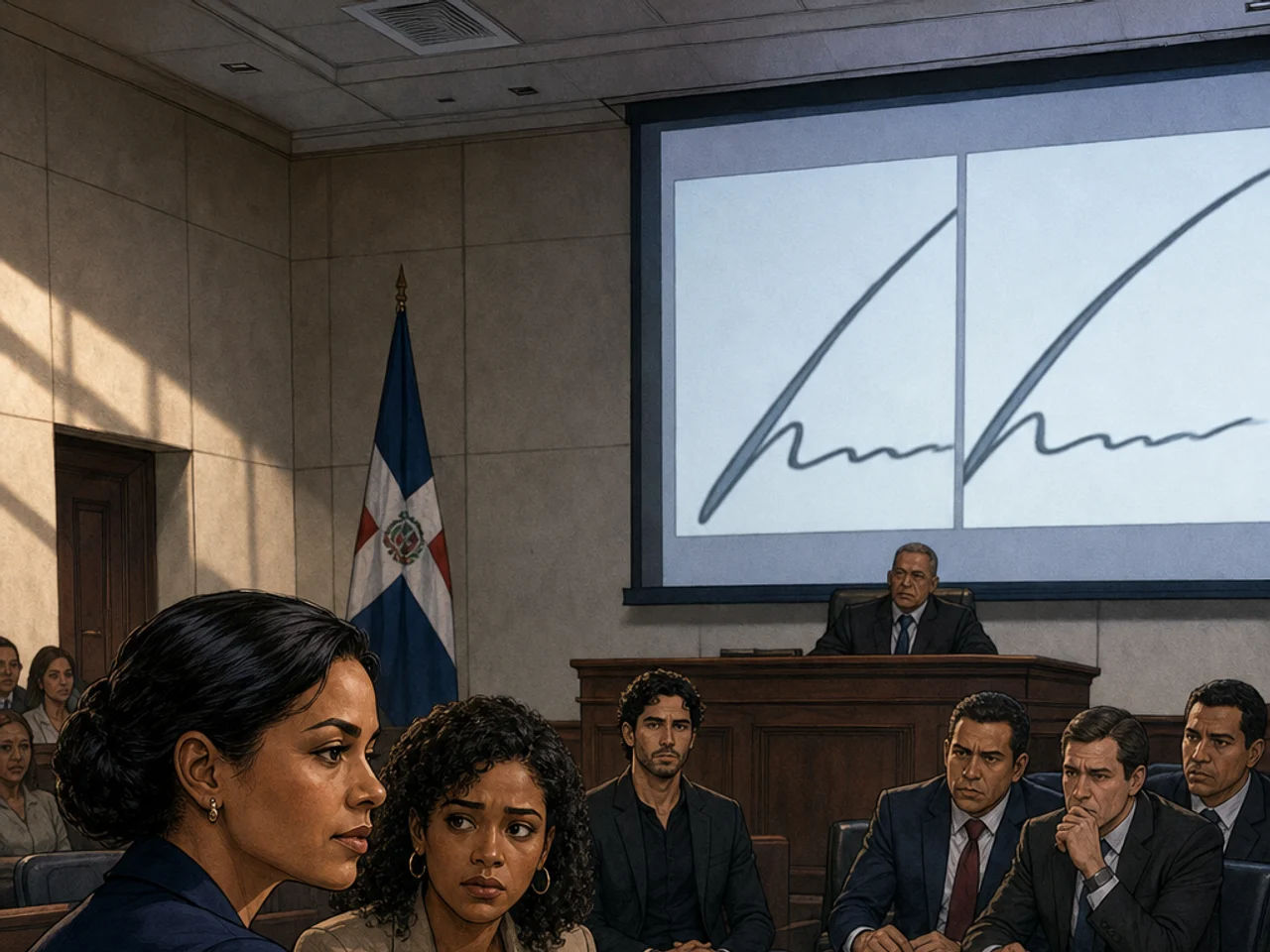
Visual description
In Santo Domingo civil court, Elena Gómez places three evidence folders before the judge while Sofía watches beside her and Max waits behind as an expert witness.
Chapter 41
The Signature
Sofía · 3 min
Friday Morning — Civil Court of Santo Domingo
The courtroom was cold enough to preserve meat.
I sat beside attorney Elena Gómez, who had exchanged her fire-safety vest for a navy suit and three sharpened pencils. Across the aisle, Vila Development had four lawyers, two assistants, and the bored confidence of people accustomed to winning before they arrived.
Max sat behind us as an expert witness, not as my lawyer. That distinction mattered to Elena, to the judge, and—after she explained unauthorized practice of law—to Max.
Vila’s attorney argued that Imprenta Mercedes had violated the nuisance clause by operating heavy equipment, attracting police activity, and interfering with redevelopment.
Elena waited until he finished.
Then she placed three documents before the judge.
“The plaintiff has a problem,” she said. “The nuisance clause they rely upon was added in a 2019 lease amendment. Ms. Mercedes never signed that amendment.”
The lawyer rose. “The signature is on page seven.”
“It is a scan taken from a 2008 equipment-financing agreement,” Elena replied. “The print shop’s archived job tickets preserve the original document, including the torn lower corner. The same tear appears in your alleged signature page.”
Yulissa projected both images on the courtroom screen.
The copied signature fit perfectly.
A murmur ran through the room.
Elena continued. “Second, the building lies within a protected heritage corridor. Demolition or displacement of a legacy trade requires review by the Monumental Heritage Commission. Vila Development applied for no such review.”
She placed Max’s report on top.
“Third, the shop and hotel share a colonial party wall governed by a recorded maintenance easement from 1958. The plaintiff cannot alter or remove structural elements without the adjacent owner’s consent and an engineering plan. Their redevelopment proposal does both.”
Vila’s attorney looked at Max. “This report was prepared by a man facing fraud litigation in New York.”
Max took the witness chair.
“Yes,” he said. “And every calculation was independently verified by engineer Gómez and filed with the Ministry. Gravity did not ask about my divorce.”
Even the judge smiled.
Elena did not ask the court to make me rich. She asked it to deny the eviction, invalidate the forged amendment, and preserve the existing lease until the heritage review was complete.
The judge read in silence for nearly ten minutes.
My father’s press waited three blocks away. Forty years of ink and debt seemed balanced on the tip of his pen.
Finally, he looked up.
“Eviction denied. The 2019 amendment is referred for investigation. The original lease remains in force.”
The gavel struck.
I did not hear anything after that. I was on my feet, crying into Elena’s shoulder while Yulissa shouted, “¡Se salvó la imprenta!” and Tony tried to high-five a court officer.
Outside, Max waited on the courthouse steps.
“We won,” I told him.
“You won,” he corrected. “Your archives. Your signature. Your business.”
I kissed him beneath the Dominican sun.
For once, he did not save me.
He stood beside me while I saved what was mine.
Narration will appear here when the final recording is added.