Visual description
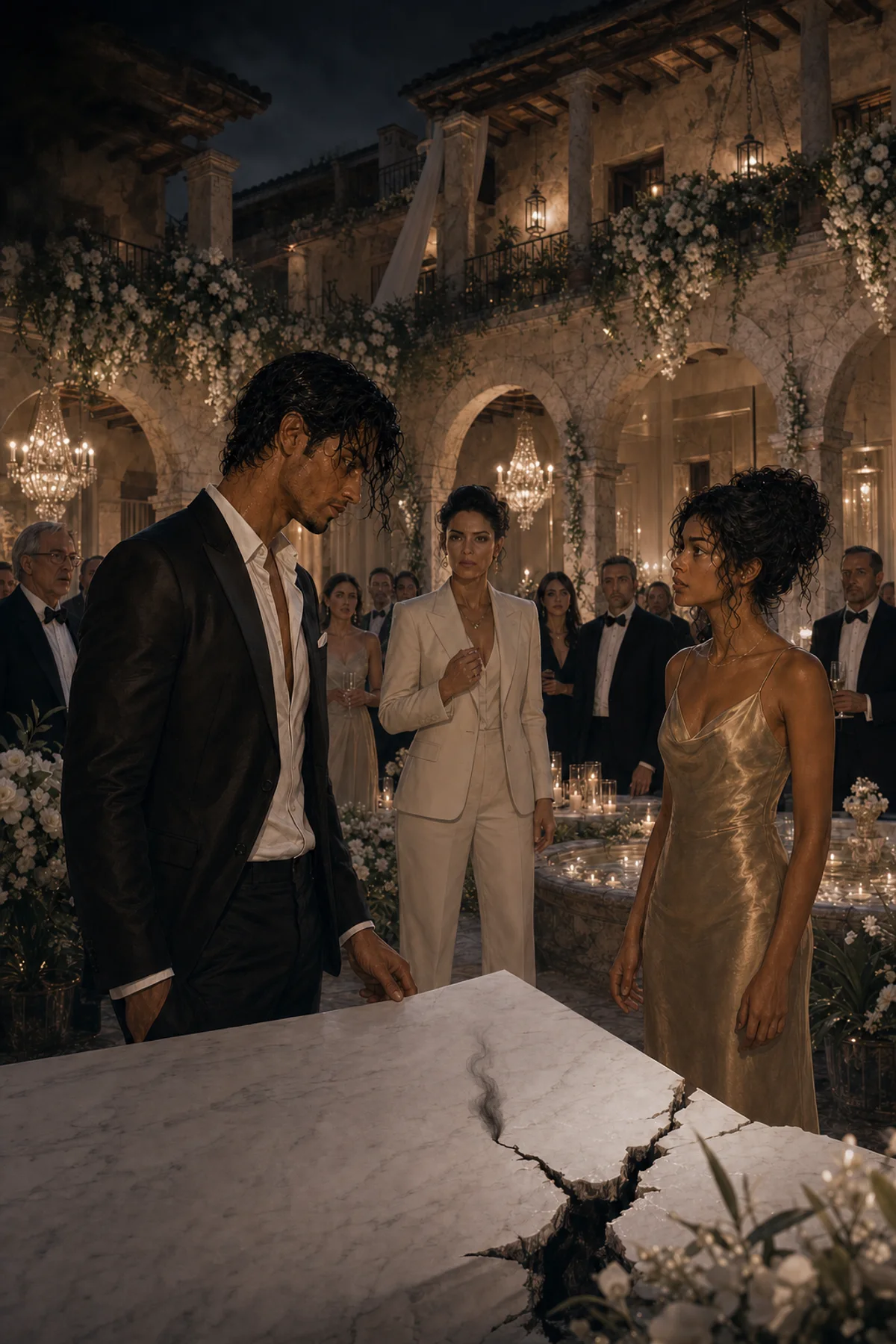
At the Hotel San Nicolás gala, a compact wisp of smoke rises from a cracked white marble slab as Max, Sofía, and Catalina confront the exposed fraud.
prologue
Dressed Like a Bride
Max · 3 min
Hotel San Nicolás — Friday Night
The marble began to smoke at 9:17 p.m.
Not burn. Not yet.
Smoke.
A thin black thread curled from the broken edge of the white slab and climbed between the crystal chandeliers, delicate as a bride lifting the veil from her face.
Three hundred guests watched it rise.
No one moved.
The investors had stopped whispering. The quartet had stopped playing. Even the waiters stood frozen, trays suspended at shoulder height, while the smell of melting resin spread through the courtyard of the Hotel San Nicolás.
Above us, the building glittered.
White flowers covered the colonial arches. Candles floated in the fountain. Imported linen dressed every table. The hotel looked radiant, innocent, expensive.
Vestida de novia.
Dressed like a bride.
And rotten beneath the lace.
Catalina stood beside me on the stage, her fingernails buried in my wrist.
“Put down the hammer, Max.”
Her voice never rose. It did not need to. For ten years, that voice had been a locked door.
I looked past her.
Minister Rafael Castillo was edging toward a side exit. Giovanni Moretti sat in the first row, his face perfectly still. Reporters were lifting their phones. Two security guards had moved between Sofía and the display boards she had printed.
She did not look frightened.
She looked furious.
That was one of the things I loved about her.
Even with powerful men trying to make her smaller, Sofía Mercedes stood in a gold dress with ink beneath one fingernail and stared straight at me.
Do it, her face said.
Catalina tightened her grip.
“You are confused,” she whispered. “You are sick. Let me take you home.”
Behind her, the smoke thickened.
I remembered another night. Rain on a funeral umbrella. A document beneath my shaking hand. Catalina’s fingers guiding the pen.
I will handle the chaos. You just stay where it is safe.
For ten years, I had mistaken a cage for shelter.
A decorative candle guttered near the sample. The courtyard’s fire alarm remained silent.
That silence frightened me more than the smoke.
The laboratory report in Sofía’s hands said the slab was mostly resin and stone dust. The inspection photographs showed sprinkler heads attached to empty pipes. The ancient hotel had been wrapped in a beautiful lie and filled with people.
“Max,” Catalina said again.
This time, I heard fear.
I looked at the perfect white slab sold as Carrara marble. I looked at the five-hundred-year-old walls hidden beneath plaster and fraud. I looked at the woman who had built my prison and the woman who had taught me how to walk out of it.
Then I raised the hammer.
A murmur passed through the courtyard.
Catalina’s hand slipped from my wrist.
“If you strike that stone,” she said, “you lose everything.”
Maybe she expected me to think of the penthouse. The firm. The Porsche beneath its canvas shroud. The reputation she had polished until I could no longer see my own reflection beneath it.
Instead, I thought of bitter coffee in a plastic cup. Mud beneath my fingernails. Doña Tata pressing sancocho into my hands. Sofía laughing in the rain. A neighborhood loud enough to wake the dead man I had become.
“I already did,” I told her.
I brought the hammer down.
The slab split with the sound of a gunshot.
Someone screamed.
And somewhere inside the walls, an alarm that should have worked remained completely silent.
Narration will appear here when the final recording is added.